Showing posts with label Strategy. Show all posts

12.11.2016

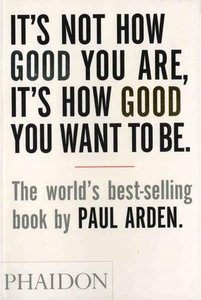
It's Not How Good You Are, But How Good You Want To Be by Paul Arden

Just like the rest of self-help books, I'm holding a reservation for this book's effectivity as soon as I can put them (Paul Arden's set of "good" advice) to test, but judging so far by how they appear, how I understood them, and how I relate my experiences to them, the result is practically a point above skepticism. It's not bad but not so great either.

Design-wise it's good, clearly given from the message inside the cover jacket that states "this book uses the creative processes of good advertising as a metaphor for business practice." Sure. The content on the other hand, shows a lot of amusing stories the ideas were based on, highly on the British author's experiences as an advertising executive. This is also good. But normally, the things we learned from personal experience are limited to how we understood that experience--what the experience meant to us.

Sometimes our understanding is cleverly spot-on, but most of the time it is limited.

Take for example his "Don't take no for an answer" idea. If you do that plainly and literally in any project, you're toast. You might also be percieved as disrespectful. Did the author performed magic to eventually earn the "yes"? Not really. There is a subtle fact that the author was able to reverse his client's decision and it's not about just not taking no for an answer, but it's about practically KNOWING how to make it a "yes". He made adjustments based on the client's negative feedback. And the next day, after begging for another presentation he earned it. It's no magic as the first time you see that mantra because it's incomplete. It should be rephrased as "Don't take no for an answer, if you know how to make it a yes." If you do not know how to make it a yes, forget it. It's just employing the value of negative feedback and persuasion.

There are more that I can add to this list of partially conceived ideas but in general and to be fair, the good ones especially the logical ones as clear as a daylight outnumber the weak ones. They are the following (along with my personal thoughts) :

The Good ones:
  • It's not what you know, it's who you know. (Painfully true)
  • Without having a goal, it's difficult to score. 
  • Your vision of where or who you want to be  is the greatest asset you have.
  • When it can't be done, do it. If you don't do it, it doesn't exist.
  • The person who doesn't make mistakes is unlikely to make anything.
  • Do not seek praise. Seek criticism.
  • Do not covet your ideas. (And a lot of us are still selfish!)
  • Don't promise what you can't deliver.
  • Do not put your cleverness in front of the communication.
  • If you get stuck, draw with a different pen.


The Weak ones:
  • Don't give a speech. Put on a show. (Putting on a show is still deceptive. Better do it naturally as you are. Live it and don't give a f#ck.)
  • It's wrong to be right. (Being right is based on knowledge, experience. The irony here is, the author tells us not to trust what is knowledge in the past, based on his knowledge of the past also. He's practically saying Experience is the opposite of being creative, folks so do not believe in what you learned from experience because I learned it from experience..WTF)
  • Have you noticed how the cleverest people at school are not those who make it in life? (Statistically wrong. The number of those who made it in life but did poorly at school is less than those unfortunate ones both in life and in school. In my experience, those who did great at school also did great in life. They are happy where they are now)
  • Don't be afraid to work with the best. (Working with the best should be the ideal. It should be "Always want to work with the best." Who doesn't want to work with Hayao Miyazaki or Peter Jackson?)

Looking at the list for now removes my initial feeling that buying this book is probably just a money-grab on behalf of Phaidon. I know that there is something good in this one but also I'm not looking for more unless somebody convinces me otherwise.



Genre: Self-help, Business, Advertising
Rating: 3 ideas based on experience that cannot be trusted

7.16.2016

If good sense stands alone, it will be taken as madness


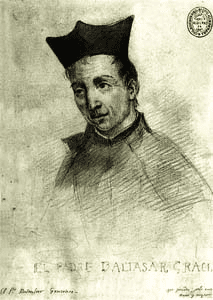
This is one of the Penguin Little Black Classics "selections" that is surprisingly applicable to both the modern and the postmodern times, the Gen X and the Millennial generation. Taken from The Pocket Oracle and the Art of Prudence---a Spanish priest's collection of maxims on using guile and pragmatism to succeed in a dangerous world, I find this selection highly progressive and advanced from its year of publication in 1647.  Translated from Spanish by Jeremy Robbins, I find Gracian's maxims as 90% agreeable and 100% insightful. And it is certainly more than how to use your enemies. It's more of using your common sense.

I also believe most of The 48 Laws of Power by Robert Greene were based on this work by Baltasar Gracian because I see a lot of similar ideas (Never outshine your master, conceal your intentions, etc.) between the two books. Though it remains a theory given that I have yet to read the whole book by Greene and I'm using my assessment on its synopsis and back cover blurbs available in the book store and online.

Some of my favorite maxims (including the title of this post):

An image is made sacred not by its creator but by its worshipper.

Whoever wants to make their own opinion the measure of all things is an insufferable fool.

Enemies are of more use to the wise man than friends are to the fool.

The most independent person must still accept the need for friendly advice; even a monarch must be willing to be taught.

Get used to the bad temperaments of those you deal with, like getting used to ugly faces.

Your will must be tenacious, not your judgement.

Take a joke, but don't make someone the butt of one.

The masses, ever critical, will not recount your success, only your failures.

Ability and greatness must be measured by virtue, not by good fortune.


Genre: Maxims, Selection
Rating: 4 images out of 5

6.26.2016

To change with change is the changeless state

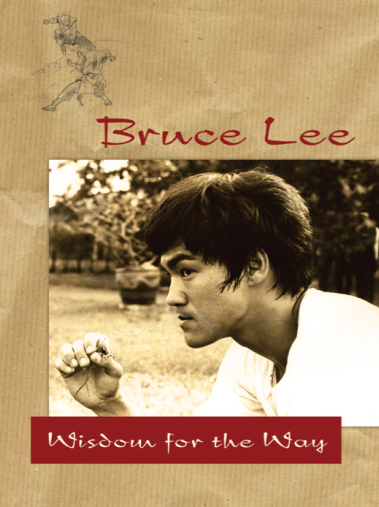
Even if Bruce Lee was never my favorite fighter in history (he is in my top five though), this book deserves a 4 star rating for his wisdom, sincerity and character-driven philosophy far from his Hollywood-celebrity persona. His first idea ("Be water my friend") clearly grabs your attention and will assure you that you can expect solid punches for the duration of the book. Moreover, he is also skillful in illustrating dynamic scenes that perfectly fit into his popular (like the title of this post) and non-popular mantra.

Genre: Collection, Philosophy, Non Fiction
Rating: 4 nonchaku


12.18.2014

Underdogs, Misfits, and the Art of Battling Giants

illustration by Rickey Beckett

DAVID & GOLIATH is my second Malcolm Gladwell read after THE TIPPING POINT (eight years ago) and the author once again provided intriguing and inspiring simplification of seemingly complex ideas and stories rooted in the socio-cultural layer of our history.

Three thousand years ago on a battlefield in ancient Palestine, a shepherd boy killed a mighty warrior with nothing more than a pebble and a sling. David & Goliath were never part of a myth as David's story is more than a legend and more than a piece of inspiration. With support from history scholars and scientists, Gladwell was able to explain that things do not really mean what they seem---especially when you look down at the underdogs and misfits. And turning the table to the one who cast a look; the very thing that makes people so intimidating can be the source of their greatest weakness.

Additional to David and Goliath story, sample stories of the French Impressionists, the German bombing of London, the Northern Ireland conflict between Protestants and Catholics, the American Civil Rights Movement, even up to the modern day coaching of basketball prove that misfits can significantly overcome obstacles and disadvantages by using the "disadvantage" itself, among other rules (and breaking of some rules).

Gladwell made it clear that David is the complete antidote to Goliath no matter the size and the skill differential. You cannot fight fire with fire as David became water to Goliath's fire and we all know who emerged victorious and who is left lifeless on the ground with a hole in the head from that glorious day of battle in ancient Palestine.


Genre: Strategy, Psychology, Business
Rating: 4 big fishes in a small lake

6.12.2014

Seth Godin's THE DIP

"Quit the wrong stuff. 
Stick with the right stuff.
Have the guts to do one or the other."

One of the best characteristics of a strategy book is being brief. Another one is being easy to understand. Written by the creator of Squidoo, the book may not be necessarily agreeable as per reader, but a little push is something we might just need in improving ourselves within the dynamics of the current professional ecosystem. But the basic ideas you can learn here is applicable anywhere and in any forms of relationship be it organizational or one-on-one. Illustrations by Hugh Macleod provide an additional comic relief.


Genre: Strategy
Rating: 4 pawns

4.09.2012

David Gemmell's LEGEND

Heroic fantasy has never been this good. This novel currently earns the 4.5/5 (132 reviewers) rating of approval from Amazon and Shelfari readers and 4.18/5 (3580 reviewers) from folks at Goodreads. Originally published in 1984, this first published book of the Drenai series is actually the final story for Druss the Legend. Just like the lead character Paul Atreides in Frank Herbert's DUNE, Druss owns a lot of monicker to his friends and enemies.  In Ventria he is known as Druss the Sender and in Vagria he is known as the Axman. To the Nadir he is Deathwalker while in Lentria he is the Silver Slayer. As a living hero of his land, his reputation as Captain of the Ax precedes him to any place or territory of operation. He is the thinking man's version of Conan and King Leonidas. It is important to know that this hero already accomplished a lot in his adventures and this book---the final story will also be his final adventure.

There is complexity and realism with the story, and the main plot here about defending a fortress from a military siege can easily compete against any memorable siege story like Battle for Helm's Deep or Battle for Minas Tirith from Tolkien's ultra popular Lord of the Rings trilogy. The forces of Dros Delnoch will recieve reinforcements but still the enemies greatly outnumber the defensive ranks. Druss the Legend will need everything to lift the morale of the defense by inspiration and strategy. The Battle for Dros Delnoch lasted for months (3 months at least) and if you're a military historian, this novel might remind you of the 13-day Battle of the Alamo, or more recently World War II's Siege of Leningrad that lasted 872 days.

It is a fantasy given the magical elements of dream visions, mind reading, mystic skirmishes and rituals, the resurrection, but it has also some scientific and real life elements like cancer, poisons, gangrene, military strategy, spies, and war casualties. David Gemmell never overused the fantastic elements and like Tao or the "force" for Jedi Knights, the mystic group of Serbitar believed in the eternal Source. I already stated about Conan and King Leonidas before and additionally I also saw characters resembling King Arthur, Robin Hood, Lady Marian, and King Xerxes including their background stories. The notoriety of Druss' equally legendary ax--the Snaga is also one of the highlights in the novel. The gritty realism of war is the novel's rallying point, you will feel the chill of unexpected decapitations and the anticipation of when will they happen next. Just like GRR Martin's Song of Ice & Fire series, look out for betrayals, assassinations, and coup. A lot of characters and people were involved but its good to see that most of the characters grew up with the story. One of the main characters dying from a disease before the great siege also adds up to realism and shock value.

Gemmell's multi-perspective narrative is also helpful in this novel. There is no black & white in this book. As a common reader who encounters any heroic fantasy or epic fantasy, I assumed that this novel would be all about Druss and what makes him a Legend. But I was completely wrong. The legend here does not belong to one man. The legend belongs to all men and women who served, fought, and died defending the six walls of Dros Delnoch. David Gemmell admits of growing up hearing idealized stories of heroes that never lied, evil never triumphed, and love as always true and it's here in this novel that we would see these undying themes without boredom.

All in all, it was a frikkin good trip. Listed in 1001 Books You Must Read Before You Die, it is highly recommended for lovers of epic and heroic fantasy before they die.


Category: Genre, Epic, Fantasy, Mature Reading
Rating: 4.5 bronze armors out of 5

3.23.2012

Adventure Defined


“A man practices the art of adventure when he breaks the chain of routine and renews his life through reading new books, traveling to new places, making new friends, taking up new hobbies and adopting new viewpoints”  

W. A. Peterson

10.17.2011

Yeng Remulla's "Productive Pinoy"

This book is one of my "flash reads" this year. Meaning, I was able to read and finish them inside a book shop, or library. This book by Yeng Remulla is just one of those motivational and strategy books available in the market today. The cover design got my attention first and it took me less than an hour to browse through it and identify the highlight points of the author.

This book targets the Global Pinoy and his family to invest on the monthly remittances. The book is mostly about the best use of money, time, and opportunity. Nothing is new with this one. If you know some of those instructional, motivational, and entrepreneurial authors, you can see parts of their ideas within this book. In these pages I saw Stephen Covey, Robert Kiyosaki, Francis Kong, Francisco Colayco, and Alex Lacson.

With or without citation to the original authors, I would still commend Yeng Remulla for being able to express those ideas in a lighthearted and positive way, the way most Filipinos like to "read" a book. Remulla wrote with humility and his style is basically Pinoy for both the experienced and the novice reader. I just hope those who loved reading this book would also be able to apply the philosophy.


Genre: Motivational, Strategy
Rating: 3 pieces of Siomai 

4.24.2011

What is The Element?

This enlightening and assuring book made it to the 4th spot on my list of best strategy books in the post-industrial era. Dr Ken Robinson got a keen eye in dissecting histories of misunderstood and miscast individuals performing unbelievably high standards of professional and artistic work after discovering where their personal passions and their aptitudes meet, and binding them in unison. He also made a very good analysis on the current system of education that dwells on the past system of standardized mass-production and assembly line, “selling” education like meals from a fast food outlet. Creativity should never be treated like that. Applied imagination has an identity, and a soul, too.


PhotobucketThe lives of Sir Paul McCartney, Matt Groening, Gillian Lynne, Richard Feynman, Meg Ryan, Chuck Close, and Paulo Coelho can attest against this traditional system of education that almost hampered them in discovering their own personal worth and identity if not from their own perseverance to follow their hearts and their instincts and with some element of luck and positive outlook, meeting exceptional mentors that helped them to continue moving forward.

This current system of education limits the child’s creative development by concentrating the curriculum into compartmentalized subjects applied separately from each other. Science is usually favoured over arts, mathematics over music or sports. What Dr Robinson proposes is for the educator to teach art as important as science, and music as with mathematics especially in the public schools.

This is really not a new concept but human development is never complete without improving the individual and the collective creativity and if you limit education by designing students to become technical workers, the child’s education remains partial. Nobody wants to see their children learn that way, to become future automatons. We mean of synergy here as unifying science, art, music, and athletics in one learning experience.
 
Anyway, I encourage you to try this if you’re looking for a good non-fiction read this year. You will be happy to find yourself in it.


Memorable Quotes from the book:

“Children learn best when they learn from each other and when their teachers are learning with them.”

“You can’t be yourself in a swarm.”

“Often we need other people to help us recognize our real talents. Often we can help other people to discover theirs.”

“Never underestimate the vital importance of finding early in life the work that for you is play. This turns possible underachievers into happy warriors.”


Genre: Personal Strategy, Modern Philosophy, Applied Philosophy
Rating: 4 sticks of crayons

11.03.2010

The Bottom Line

Photobucket
MAGINOO - FIGHTING AGAINST EXTINCTION
"Trials, temptations, disappointments -- all these are helps instead of hindrances, if one uses them rightly. They not only test the fiber of character but strengthen it. Every conquering temptation represents a new fund of moral energy. Every trial endured and weathered in the right spirit makes a soul nobler and stronger than it was before."

James Buckham
     (1844-1930)

2.09.2010

An Undefeated Code

ZEN
The idea of Zen is popular---we all have preconceived notions around it. But the real practice of Zen is sublime in the sense that only a few people practice it in a proper and formal way, consciously and diligently. Zen is a philosophy of will power and is based on a spirit of self-reliance. Additionally, profound honesty is also required. It transcends religion (but not hostile against the existing religions) and committed only to the religion of the self - to master thy own self, a personal strategy. Zen practitioners are not selfish, they are basically selfless as they place themselves in the same responsive relationship with Nature and the universe.

If you consider reading as philosophy, you will definitely like this one written by a great bushi (who later became a Ronin) sometime in 1643 A.D. Reaching the age of sixty and learning from his battles against other swordsmen and students of the sword fighting schools (he never lost a fight in his lifetime), Shinmen Musashi No Kami Fujiwara No Genshi or commonly known as Miyamoto Musashi wrote a series of discourses for his student (Terao Magonojo) on the mastery of self by practicing the path of Heiho under the guidance and philosophy of Zen. This series of writings collected in one book-- the Book of Five Rings focused on the practice of Heiho is divided into five major chapters, or books (rings).

From the translators of the book, there is the passive way and the active way of practicing Zen. The active way is what The Book of Five Rings (Go Rin No Sho) is all about.


Utagawa Koniyushi - "Miyamoto Musashi slaying a giant Nue"

HEIHO
Before diving into the Five Rings, we need to understand first The Path (or the Way).

Musashi devoted himself to the path towards enlightenment since his youth, and had his first match at the age of thirteen. Winning battles after battles against fellow swordsmen, he finally abled to formulate a disciplined strategy in winning fights and eventually master his own destiny. He called this path Heiho.  
  
There are 9 basic commandments of Heiho:   

1. Do not harbor sinister designs.

2. Diligently pursue the Path of Two-Swords-as-One.

3. Cultivate a wide range of interests in the arts.

4. Be knowledgeable in a variety of occupations.

5. Be discreet regarding one's commercial dealings.

6. Nurture the ability to perceive the truth in all matters.

7. Perceive that which cannot be seen with the eye.

8. Do not be negligent, even in trifling matters.

9. Do not engage in useless activity.

The code of Heiho is more than just a written list on a book. It teaches us to study more, and practice harder. And getting informed is the first step. This is Miyamoto Musashi's "undefeated" code. To study more and practice harder. He reiterates this obviously after every end of both the major and minor chapters of his book.


THE FIVE RINGS (BOOKS)

The Five Rings are composed of The Earth Book, The Water Book, The Fire Book, The Wind Book, and The Book of Emptiness (Void).


The Earth Book (Chi No Maki) centers on the path of Heiho, about fighting with a goal and no hesitations. It's about widening your peripheral vision and putting your mind above all things and be objective at all times.

The Water Book (Mizu No Maki) tackles on the basics of the sword fight, the importance of initiating the stance and studying the reactive response of the opponent, as he introduces the term "rhythm" vital for the fight itself and elaborates further on the proper initial stances.

The Fire Book (Hi No Maki) explains the strategies in the middle of the fight, the importance of "offensive" stance over the "defensive" stance and looking for right timing at the opponent's momentary weaknesses. More techniques and variations in combat are explained here.

The Wind Book (Kaze No Maki) tells about the weaknesses and strategies of other schools of sword fighting (those considered not of Heiho). Miyamoto explains how to counter the strategy of the other schools.

The Book of Emptiness (Ku No Maki) is understanding that the nature of reality is a process, a flow and implies that one has gone beyond the point of making destinctions, creating dualities. Nothing is absolute in this world; everything is always changing. Musashi teaches us that you have your own flow, your own process and suggests there is a higher order of experience than the one you are on now. That emptiness is actually fullness, the realm of all possibilities.


some memorable passages:

At present, in many of the martial arts, and especially archery, there is too much concern about appearance, and not much concern about substance. That kind of martial art is useless in critical moments...

The primary principal is to have the sun behind you. Take a stance with the sun behind you. If it's not possible due to the lay of the land, keep the sun to your right...

There is also the concept of "intoxication"... It involves getting the opponent bored, agitated, and giving him the feeling that you are inferior. This should be well thought out... 


Genre: Strategy, Oriental Philosophy
Rating: 4.5 maki out of 5