Showing posts with label Classic Philosophy. Show all posts

7.16.2016

If good sense stands alone, it will be taken as madness


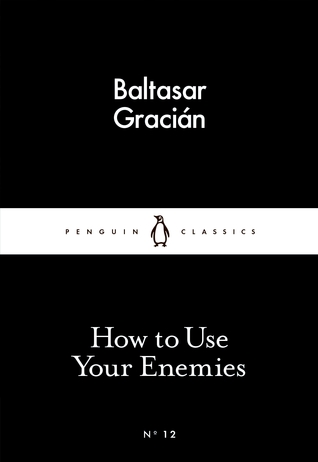
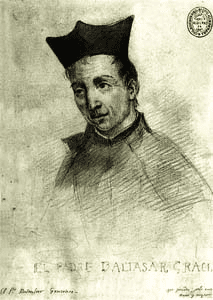
This is one of the Penguin Little Black Classics "selections" that is surprisingly applicable to both the modern and the postmodern times, the Gen X and the Millennial generation. Taken from The Pocket Oracle and the Art of Prudence---a Spanish priest's collection of maxims on using guile and pragmatism to succeed in a dangerous world, I find this selection highly progressive and advanced from its year of publication in 1647.  Translated from Spanish by Jeremy Robbins, I find Gracian's maxims as 90% agreeable and 100% insightful. And it is certainly more than how to use your enemies. It's more of using your common sense.

I also believe most of The 48 Laws of Power by Robert Greene were based on this work by Baltasar Gracian because I see a lot of similar ideas (Never outshine your master, conceal your intentions, etc.) between the two books. Though it remains a theory given that I have yet to read the whole book by Greene and I'm using my assessment on its synopsis and back cover blurbs available in the book store and online.

Some of my favorite maxims (including the title of this post):

An image is made sacred not by its creator but by its worshipper.

Whoever wants to make their own opinion the measure of all things is an insufferable fool.

Enemies are of more use to the wise man than friends are to the fool.

The most independent person must still accept the need for friendly advice; even a monarch must be willing to be taught.

Get used to the bad temperaments of those you deal with, like getting used to ugly faces.

Your will must be tenacious, not your judgement.

Take a joke, but don't make someone the butt of one.

The masses, ever critical, will not recount your success, only your failures.

Ability and greatness must be measured by virtue, not by good fortune.


Genre: Maxims, Selection
Rating: 4 images out of 5

10.30.2015

Sketchy, Doubtful, Incomplete Jottings of J.W. von Goethe

As a derelict reader of philosophy, I can only measure Johann Wolfgang von Goethe's musings on self-deceit, superstition, art, and ambition practically at face value. I imagined arming myself with a spade before reading this edition-- a Penguin books short collection from the German author/philosopher's original Maxims and Reflections (1749-1832) only to realize that I do not need any digging for deeper meanings because the proof is already in the surface. Well-known for his legendary novel Faust, most of Goethe's musings here are obvious to the open eyes.

"Nobody can make judgements about history except those who have experienced history as a part of their own development. This applies to whole nations. The Germans have only been able to judge literature since the point they themselves have had literature."

If he could only survive more than a century later, I am sure he will be thinking of how his countrymen judge their position in the world regarding War and Antisemitism. These next musings are not far from the first:

"Only those people who are both clever and active, who are clear about their own capacities and can use them with moderation and common sense, will really get on in the world as it is."

"Whichever way you look at nature, it is the source of what is infinite."

In general one doesnt need a mind of a genius to agree or disagree with his observations and maxims even if some were obviously outdated and most were flatly acceptable as they are. At the same time I could not consider them nearly as thought-provoking. Goethe's ideas were enjoyable as food for thought, but not so revolutionary.

My final pick from his collection may describe the current state-of-affairs regarding the book reading world, something to think about:

"The most mediocre novel is still better than mediocre readers, indeed the worst novel still participates in some way in the excellence of the genre as a whole."


Genre: Opinion, Maxims
Rating: 3 paintings

10.10.2012

The Bad Mofo Said


The path of the righteous man is beset on all sides by the inequities of the selfish and the tyranny of evil men. Blessed is he who, in the name of charity and good will, shepherds the weak through the valley of the darkness, for he is truly his brother's keeper and the finder of lost children. And I will strike down upon thee with great vengeance and furious anger those who attempt to poison and destroy My brothers. And you will know I am the Lord when I lay My vengeance upon you.

Ezekiel 25:17
Jules Winnfield version from Pulp Fiction.

3.23.2012

Adventure Defined


“A man practices the art of adventure when he breaks the chain of routine and renews his life through reading new books, traveling to new places, making new friends, taking up new hobbies and adopting new viewpoints”  

W. A. Peterson

11.03.2010

The Bottom Line

Photobucket
MAGINOO - FIGHTING AGAINST EXTINCTION
"Trials, temptations, disappointments -- all these are helps instead of hindrances, if one uses them rightly. They not only test the fiber of character but strengthen it. Every conquering temptation represents a new fund of moral energy. Every trial endured and weathered in the right spirit makes a soul nobler and stronger than it was before."

James Buckham
     (1844-1930)

9.15.2010

Cups of Tea @ Jeannie's Inn

Photobucket
First of all, I appreciate the fact that a friend shared me a "copy" of this book. I am also thankful that she allowed me to highlight passages and write my personal notes on the pages as much as I like doing it to any book (it was actually, her idea).

Reading a copy of this booklet gave me a feeling that perhaps I also own it, not in a proprietary way but in a spiritual way. Because sometimes, a book or an idea come to our lives at the right place and at the right time to remind ourselves on what really matters in this superficial and transitory world, and spiritual happiness will never be real if you don't share it.

This book by Jeannie Javelosa reviews and reiterates the timeless wisdom of Eastern Mysticism and Philosophy as applied to the current age of romantic and spiritual relationships. Even if I do not completely agree with all the beliefs on the mystical side, the author wrote not in a preachy tone but in a friendly and simplistic manner that made me value the book more. Reading it reaffirmed and fortified my principles as an individual, as a friend, and as a member of an evolving universe hungry for life, love, and ultimately, redemption.


my favorite lines:


"For those who battle the hardest to keep Life despite all odds, they face the experience of Love's supreme sacrifice...where the couple moves through the soul darkness of experiencing  the deepest loneliness and grief of learning to let go."


"Nothing happens in our relationships that we do not bring about by our own free will."


"This great karmic plan of God, with its inherent wisdom, knows that the coupling of people stems from the need of each one to learn the best lessons each can derive from the other. When these lessons have been learned, then it's time to move on."


"Each one comes into your life for a purpose and nothing was ever a mistake."


"People are in our lives for a reason, some for a season, others for a lifetime... Let us therefore not take them for granted."


"Love can lift you beyond yourself. It can also make you dive deep inside."


Rating: 4 cups of tea
Genre: Philosophy, Spirituality, Relationships

8.22.2010

The Reader's Manifesto # 8


"I have often reflected upon the new vistas that reading opened to me. I knew right there in prison that reading had changed forever the course of my life. As I see it today, the ability to read awoke in me some long dormant craving to be mentally alive."

Malcolm X

7.02.2010

Master Fabulist

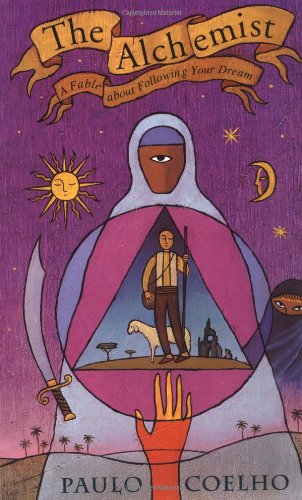
That's how I think of Paulo Coelho after reading The Alchemist. The book originally published in 1988 is very inspirational and as I see it,  highly comparable to Antoine de Saint-Exupery's "The Little Prince." The setting and backdrop for both novels are actually similar (the desert, in the heart of Middle East and Africa) but I am not the one to answer if it's coincidental or intentional on Coelho's part.

Still, this book has a lot of quotes and passages for a lover of spiritual creeds and believer of truisms, passages that are worthy to share here:

Whenever we do something that fills us with enthusiasm, we are following our legend.


We do not realize that those who genuinely wish us well want us to be happy and are prepared to accompany us on that journey.


Fall seven times, and stand up eight.


Fear of suffering is worse than the suffering itself.


Intuition is really a sudden immersion of the soul into the universal current of life, where the histories of all people are connected, and we are able to know everything , because it's all written there.


God only rarely reveals the future. When he does so, it is for only one reason: it's a future that was written so as to be altered.


Every search begins with beginner's luck. And every search ends with the victor being severely tested. 


True Love never keeps a man from pursuing his Personal Legend.


When we love, we always strive to become better than we are.


Life attracts life.


Rating: 4 caravans out of 5
Genre: Inspirational Novel, Spiritual, Modern Fable, Magic Realism

6.07.2010

CANDIDE

Photobucket
Believing that he's doing the ladies a big favor, Candide killed the monkeys with his rifle. He was DEAD wrong.


Voltaire's CANDIDE is funny, fast-paced, philosophical, and outrageously WTF?! novel in a good way.

He authored this book to criticize Leibniz and his followers about optimism, as their mantra states "All is for the best in the best of all possible worlds."

He did it by injecting into the story all kinds of known tragedies (the natural, political, and the religious) in the 18th century Europe to prove that the world is not perfect and neither does man.

After criticizing the optimists, and exploring the rationality of the pessimists (but not taking their side), Voltaire actually enjoyed pitting the two sides of the argument in order to come to a conclusion safely somewhere in the middle ground.

That middle ground states that we must focus on our skills, our situation at the moment--in exact words; "We must cultivate our garden." And maybe that mantra became Voltaire's best argument that finally shaped his further works and writings as a sarcastic and humanist philosopher.

Photobucket


some memorable passages:

"Fools admire everything in a celebrated author. I read only for myself, and I like only what suits me personally."

Cacambo never lost his head. "Don't give up hope," he said to the forlorn Candide. "I know a little of these people's jargon, and I'm going to speak to them."
"Be sure to point out to them how horribly inhuman it is to cook men," said Candide, "and how unchristian it is, too."

A few days later they reached the Bosporous. Candide began by buying Cacambo's freedom at a very  high price, then he and his companions boarded a galley without delay and set off for the shore of the Sea of Marmora to find Cunegonde, however ugly she might be.


Rating: 4 pistachio nuts out of 5
Genre: Philosophy, Classic Lit, Humor