Showing posts with label Historical Fiction. Show all posts

8.12.2015

Michael Punke's The Revenant

I was expecting an explosive slam-bang ending but the epigraph (Romans 12:19) stated it clearly albeit differently. It's basically a revenge story with a surprising kill-joy ending, but the commendable quality of this novel by Michael Punke hinges on the realistic and brutal depiction of a frontier life ever since the historical adventures of Lewis and Clarke. If you love scouting and surviving the outdoor life mostly within the winter-spring seasons, you will enjoy this book.

The reader may be treated with a story of one man's obsession for vengeance, but the author's effort in searching historical documents about the life of Hugh Glass and the history of the Rocky Mountain Fur Company while infusing them with legend aptly defined the novel. What stood out here is the balance between fact and fiction, history and legend.

Passing that balance category probably made the novel also pass the threshold of a film material, as the movie adaptation will be released by December this year with the main hero Hugh Glass being portrayed by Leonardo DiCaprio. The ending may be different from the novel and I'm looking forward to it.


Category: Historical Fiction, Survival, Action, Adventure
Rating: 3-foot hunting rifle

11.14.2014

Tabi Po Isyu 2 ni Mervin Malonzo

Ito ay karugtong ng naunang isyu kung saan ipinakilala ang kasaysayan ni Elias bilang isang aswang (kasama ng kanyang mga kauri) noong panahon ng mga Kastila. Hindi ako nanghinayang sa pagpunta kanina sa AKLATAN (kauna-unahang "All-Filipino Book Fair" sa bansa) sa Bayanihan Center para sa ikalawang isyu na ito dahil sulit hanggang sa huling sentimo. Wala pang hassle sa pagpila sa libreng pirma at kumustahan sa may akda dahil wala naman talagang pila pero tingin ko'y ibang istorya ang magaganap bukas sa Komikon dahil siguradong dadagsain ang book signing nito.

Salamat sa may akda at sa mga tumulong sa kanya para ituloy ang kuwento. Sadyang mahusay ang pagkakagawa. Kung meron man hindi na ako makahintay sa posibleng pagkikita ni Elias kay Ibarra sa mga susunod na isyu.

Kategorya: Horror, Historical Dark Fantasy, Mature Reading, Komiks
Marka: 4.5 tasa ng mainit-init na Salabat

11.07.2014

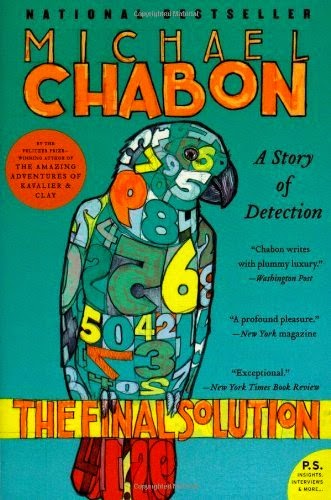
The Final Solution: A Story of Detection by Michael Chabon

I just simply like how the story ended.
Imagine what happens to Sherlock Holmes years after his retirement in the business, service, and art of crime detection. This is that book.

It's also cool to catch a glimpse of life (beyond the cliched borders of deductive reasoning) reflected from the eyes of the legend himself:

 The application of creative intelligence to a problem, the finding of a solution at once dogged, elegant, and wild, this had always seemed to him to be the essential business of human beings--the discovery of sense and casuality amid false leads, the noise, the trackless brambles of life. 

And yet he had always been haunted--had he not?--by the knowledge that there were men, lunatic cryptographers, mad detectives, who squandered their brilliance and sanity in decoding and interpreting messages in cloud formations, in the letters of the Bible recombined, in the spots on the butterflies' wings. One might, perhaps, conclude from the existence of such men that meaning dwelled solely in the mind of the analyst. That it was the insoluble problems--the false leads and the cold cases--that reflected the true nature of things.

This is my second Michael Chabon read after Gentlemen of the Road and it's been a worthwhile journey.


Genre: Mystery, Historical Fiction
Rating: 3.5 alphabet songs

3.17.2013

The Hundred Year Old Man Who Climbed Out of the Window and Disappeared


How catchy and outrageous can a title get?

More than you can imagine. On the surface, you would think that this is just one of those novels with the basic 'around-the-world-in-XX-days' premise or perhaps another adventure and romp through 'space and time.' But this one is an exemption deserving to earn the reader's attention, especially for somebody out there who loves history and travel. This is not just an adventure story of one person--a centenarian with a Masters in Explosives title in his proverbial "resume," but a story of a group--and how they were able to unite themselves like a family when only weeks ago they were perfect strangers to each other, some even wanting to kill another. What the F right?

It's so tempting to compare Allan Emmanuel Karlsson with Forrest Gump. I can see it from book reviews in Amazon, Shelfari, and Goodreads. But I refuse to compare the two even if they have something in common, and that is coming from the simple lifestyle in the suburbs. The two may be fruits, but you can't compare apples to oranges (or to lift a comparison from the book--you can't compare vodka to banana liquor). With or without being aware of it, Forrest Gump have done something for American history. But Allan Karlsson have done lots of things for World History in crazy and funny ways. If you love WWII stories, you will appreciate this book more. Allan Karlsson provided his expertise and antics in World History after meeting an all-star cast of characters like General Franco, J. Robert Oppenheimer, Harry Truman, Winston Churchill, Joseph Stalin, Soong May-ling, Chiang Kai-shek, Mao Tse-tung, Kim Il Sung, the young Kim Jong Il, Lyndon Johnson, Charles De Gaulle, and Richard Nixon. And to top it all, there's an elephant, and a dog to join the party too.

As a novel I can say it's well-written by a Swedish author with a background in journalism. After Stieg Larsson and Jo Nesbo, the popular Nordic invasion of Western Literature rages on and it is here, surprisingly in the form of a funny story by Jonas Jonasson. It's a welcome and a cool departure too from serious themes of murder and detection by Larsson and Nesbo.

If you're a Filipino, just take it easy on the notoriety of formalin-induced Swedish meatballs made in the Philippines mentioned twice in the novel. Formaldehyde is of course, not country specific and anyone can do it anywhere but at least, it's nothing against the cardboard-filled Siopao buns made in China. Your choice--Bola-bola or Asado?


Genre: Historical Fiction, Adventure & Comedy
Rating: 4.5 bags of Swedish meatballs from the Philippines

6.30.2012

When The Elephants Dance by Tess Uriza Holthe


This is my first attempt in joining Read Philippines' Book of the Month for June 2012. I actually voted for this novel, but this book originally published in 2002 has its flaws. I can see that it's not very realistic, nor strictly contextualized in the Philippine setting and this would have explained why most readers of Asian Historical Fiction remained neutral and would prefer the more prominent Ilustrado novel by Syjuco as a recommended text. This book probably needs an editor but it's understandable given the enthusiasm of the author (she tells it like a balikbayan sharing her own adventures from a strange land) in forming a synergy of variable folk and war stories to become a singular novel in the end.

Here are what I notice:
  • The title itself. Used by a Filipino patriarch as an analogy of the Second World War to his children, elephants were depicted as the American and Japanese forces while the chickens scampering were pictured as the Filipinos. On the surface it may sound appropriate since elephants are essentially foreign animals to the country just like the Japs and the Americans but the father in the story used an analogy, and I think it's better to use an animal that all children in the war-thorn Manila were familliar like a water buffalo or carabao. There are no elephants in the Philippines, not yet in the zoo during the war thorn era of WWII. I prefer to rephrase what Mang Carlito said in the book like this: "When the buffalos dance, the chickens must be careful." It's much easier (and amusing) to imagine it as a Filipino child.
  • Another contextual miscue is the usage of "snow" in a simile. "The evenings in our cordillera village were always deliciously hot, with the scent of the white sampaguita flowers that grew like flakes of snow around our house." The narrator here is a Filipino native in WWII telling a childhood story to Filipino audience, asking them to imagine snow flakes sprouting around the house. The problem is, there's no snow in the Philippines.
  • "All Soul's Day, also known as Todos Los Santos, happened on the evening of October 31. Halloween, they call it in the States." What happens on the evening of October 31 is indeed Halloween, and then All Saints Day or Todos Los Santos the following morning of November 1. However, All Souls Day or Araw ng mga Patay, occurs on November 2. 

I dont want to elaborate further on some spelling and historical miscues (like the weird prominence of Boracay in 1940s) nor ponder on the "uncharacteristic" breakdown of a revolutionary hero and the sudden fear of bleeding to death when you already killed a lot and can easily kill more human being. But we all know that a coin has two faces and seeing the brighter side of the novel is still a rewarding and probably redeeming act. Reading the fantastic stories full of traditional values like unity and sense of family inspires me more not to let go of the colorful history of my people's race in Asia.

There is no contention that the author Tess Uriza Holthe was inspired by her father's experience as a young boy in this country during the second World War. You can sense her enthusiasm and pride in retelling the folk tales we are all familiar with as Filipinos, and it's admirable. It was an amalgam of stories within a story, sometimes amusing, sometimes inspiring, and also heartbreaking. It's probably the best description of this novel, as it mirrors the collective Filipino and its struggle for independence and sense of national identity from its Asian, Hispanic, and American experience.

My favorite quote from the book: "I do not hide, Alejandro. Remember this day. Remember how everyone fought together. Keep it in your heart, and never let anyone divide us again. As for me, I will try to build something from what remains. My soul needs time to heal. I go now to see where this new peace shall lead us. Please, tell the others goodbye." 


Genre: Historical Fiction, Folk Tales, WWII, Anti War Literature
Rating: 3.9 kilos of rice 

6.03.2012

Kwentillion: Premiere Issue


published by Summit Media

The superb cover art by Chester Ocampo can easily square off with any artist of the adult-oriented Heavy Metal magazine in the US but it's important to emphasize this early that this premiere issue is very much suitable for general patronage now known as the YA generation. The short story by Budjette and KaJo is once again a good work (and another quality young heroine of Trese tradition) while Poso Maximo by Robert Magnuson is highly enjoyable. I can only wonder if the young heir of Datu is directly related to the world of Alexandra Trese but this remains to be verified. High Society by Chikiamco & Buena is a noteworthy read.  Andrew Drilon's The Secret Origin of Spin-Man is a memorable short parody of the superhero genre.

Dimacali & Bumanglag's Sky Gypsies reminded me of the recent clash involving illegal Chinese fishermen and the Philippine Navy in the Scarborough Shoal but this story does not involve anything about territorial disputes and the role between the bully and the harassed is in complete reverse here. Upcoming and current stars in the world of graphic illustration can be helpful especially in knowing their influences.

Philippine Folk Magic compiled by Chikiamco and drawn by Mervin Malonzo is for me, the best feature of the whole magazine and I hope that they continue this feature for the next issues under the category of Myth-troduction. It's a good eye-opener for the uninitiated and a refresher for old followers of Philippine Mythology.

My wish so far is to finally see a good collection of mythology from our brothers in the south---the Mindanao Epic. It may be republished in a book form and not necessarily in a magazine format, as long as it follow the original narrative structure of the oral tradition. I want to read more about Prinsipe Bantugan's fall and how his friends recapture his spirit by outsmarting the Gods of the underworld. I want to see him reborn and kick his foes to oblivion with his magical Kampilan just in the nick of time. I don't mind seeing Tikbalang in a distant galaxy or a Tamawo guarding a forgotten colony ship but what I do mind is the original story. It's easy to reinvent, readapt, or retell a story in the current setting, but the challenge lies in making the mythology relevant to the young generation without sacrificing the original story and the reason why myths are being told  by our grand folks. Philippine Mythology exist to teach the Filipino a lesson, they exist to provide value not to the material, but to the unseen things like justice, honor, brotherhood, and humility.

10.25.2010

The Biggest Secret

The conspiracy theory of society...comes from abandoning God and then asking: "Who's in his place?"
             ---Karl Popper, Conjectures and Refutations, London, Routledge, 1969, iv, p. 123  

PhotobucketThere is a great danger in man's obsession with historical theories and other self-fulfilling prophecies. Time and time again the power of conviction without a solid proof is in his blood because man by nature, is a believer. There's nothing wrong with believing. The problem is in the person when he becomes obsessed.

Umberto Eco's FOUCAULT'S PENDULUM warns us of that danger. This intellectual adventure story of the first order warns us about the number of writers employing the strategy on tackling historical theories and claiming that they are most probably true (like Dan Brown did and the rest of his clones). There is a thin line that separates entertainment from truth, but when spiteful reactions spawn irresponsibly from the unproven conviction of this never ending search for the truth about the Templar Knights and other secret societies, the damage is already done to the global consciousness and the once united structure are breaking into pieces and factions before we know it. Rephrasing a nugget from the late Martin Luther King Jr,-- humanity must learn to live together as brothers if we don't want to perish together as fools.

Back to the novel, the novel actually starts near the ending and zooms you back to its origin. From that, you will take a roller coaster ride deeper into diverse narrative genres of detective stories, commentaries on the publishing world, philosophical discourses, social realism and science, nationalism, romantic love, comradeship, historical theories, fanaticism, religion, and adventure. Eco did it effectively without sacrificing his sage-like witticism and sarcasm and for that, this novel entered the literary status. If you're intimidated by the page blurb from Time saying that it's endlessly diverting, I advise you not to believe in it. The series of historical (and Jewish) addendum is important (including those medieval and hermetic quotes in the form of their original languages) for they only add up to the novel's unique atmosphere of the arcane and the secret knowledge. I consider this book as more of a Speculative History than Historical Fiction and I enjoyed the verbal antics of the major characters.          

If you're hungry for historical conspiracy theories, this book is a repository of them. And if you see yourself overwhelmed by the labyrinthine chase in history on who-dun-it and predator-prey dichotomy (the main characters talk on lots of eccentric, shadowy, historical characters like Marx, Aleister Crowley, Count Cagliostro, De Molay, et. al.) don't worry, there is an Enlightenment chapter, the main character Casaubon will summarize it all.

Another good part of this novel are the parallel stories on Casaubon's romantic struggles with Amparo, and then with Lia, and also Belbo's struggles with Lorenza and other women, and his childhood love and war stories in an undisclosed European countryside. This is surely a man's book and I will miss reading it. Eco depicted Casaubon's wife Lia to be an ideal woman. She's not scared of saying you're an idiot, and she always know how to enlighten and clear a fuzzy mind of a man absorbed in his day's work with care. Smart, gutsy, nerdy, and practical chick--an opposite to Lorenza's tempting and sultry character.

Diotallevi's wisdom of a dying man is also highly memorable, because he sees the major folly of playing with historical facts and turning them into more dangerous theories--The Plan, that their readers will easily believe without a doubt. Fanatics feed their own beliefs and Diotallevi is remorseful of that. Karma is employing Science against Diotallevi, and I admire him for being brave in facing it. It all started with The Plan; the three writers of the arcana--- Belbo, Casaubon, and Diotallevi started it all upon obtaining a secret list from an aging Colonel Ardenti, and Belbo's final resolution for all of this in facing the inevitable alone is also highly admirable. His tragic end at the Pendulum is highly symbolic.  

Overall, the novel's major message is that there can only be two answers to a secret. The first answer is a major disappointment (secrets not so very grand and epic), and the second is there's actually no secret at all.    

Tragicomic it may sound, but that is the final answer to the biggest secret of them all.


random but notable passages:


Whenever a poet or preacher, chief or wizard spouts gibberish, the human race spends centuries deciphering the message. The Templar's mental confusion makes them indecipherable. That's why many people venerate them.


Amparo had made up her mind: religion was always the opiate of the people, and pseudo-tribal cults were even worse. But when I held her by the waist in the escolas de samba, joining in the snaking lines to the unbearable rhythm of the drums, I realized that she clung to that world with the muscles of her belly, her heart, her head, her nostrils...Afterward, she was the first to offer a bitter, sarcastic analysis of the orgiastic character of people's religious devotion--week after week and month after month---to the rite of the carnival.


"Mysticism is a democratic, if not demagogic phenomenon; initiation is aristocratic."


"But nowadays all you need was information; everybody was greedy for information, especially if it was out of date."


"Oh, it's a game. I met him at a friend's place--all right? And I find him fascinating. He kisses my hand as if I were a princess. He could be my father." 
"He could be the father of your son, if you aren't careful."
It sounded like me, in Bahia, talking to Amparo. Lorenza was right. Aglie know how to kiss the hand of a young lady unfamiliar with that ritual."


"Any fact becomes important when it's connected to another. The connection changes the perspective; it leads you to think that every detail of the world, every voice, every word written or spoken has more than its literal meaning, that it tells us a Secret."


Rating: 5 laundry lists
Genre: Speculative History, Adventure, Satire, Mystery

8.01.2010

Le Professeur vs The Great Danton

Photobucket
After viewing the film adaptation of the book years ago, I wanted to hunt and read this novel by Christopher Priest which he published in UK in 1995. Even if an online book reviewer over the Amazon gave this novel an average rating and advised the readers to watch the movie instead, I thought otherwise and gave this book a try.

I was right. Reading the sci fi book turned out good and I loved it as much as I enjoyed the movie. One needs only an open mind to appreciate it. This epistolary and steampunk novel deserved both the James Tait Black Memorial Prize for Best Fiction in 1995 and the World Fantasy Award for Best Novel in 1996.

The story is brilliant in stealing your attention since the first page and you'll never get out of that thrill until you finish reading it. It stalks the reader by carefully revealing the secrets and giving you with not so obvious clues that will leave you wanting for more. It is also empathic in showing each character's viewpoint and depth, and at times macabre that centers highly on a great and mortal feud between two magicians in the Victorian Era. The only comparison I can give between the movie and the book without spoiler is that in the movie, Alfred Borden is the protagonist but in the novel the protagonist is Rupert Angier (you will hate Alfred Borden in the novel). And in the novel, the legacy of the feud passes on for generations down to their descendants to finally solve themselves the riddle.

That final scene between "brothers in identity" is very cool and eerie at the same time. If you're familiar with Tesla, he was a very important character in inventing a device that will change the outcome of the feud. 

It's nice to imagine that this book by Christopher Priest caught the attention of Christopher Nolan (whose name is the current talk of the town in directing the best film of the year Inception) to make a film adaptation of this novel which he released in 2006.

Photobucket

highly memorable passages:

"I was angry that my best illusion had been copied; I was even angrier that it had been battered. Worst of all, though, was the fact that I could not work out how it was done."

"My reunion with myself must be one of the most unusual in history! He and I were perfect compliments to each other. Everything I lacked was in him; everything I had he had lost. Of course we were the same, closer to each other than identical twins."

"With all these completed I will charge up the Tesla device again and use it for the last time. Alone, in secret, I plan to transmit myself across the aether for the most sensational manifestation of my career...I am preparing myself, rehearsing as if an audience of thousands will be watching. But this act of magic must uniquely take place while I am alone, with no one at all  to witness it..."


Genre: Sci Fi, Historical Fantasy, Steampunk
Rating: 4 out of 5 Tesla devices

5.06.2010

The Nazrani son

With slight presumptions, anticipation and foresight, I was able to finish the book and at the same time enjoy the wildest ride (so far for my A-Z challenge) into the unknown territory not very far from real history of Espionage, WWII, and Roman Catholicism in this speculative fiction masterfully crafted by Tim Powers.

PhotobucketThis book won in 2001 the World Fantasy Award and the  International Horror Guild Award but sadly due to a technical matter was adjudged ineligible for a nomination in the Nebula Award for best novel. Still, I'm glad to find a novel that blended speculative fiction with historical fantasy and espionage adventure into one delicious meal for a book eater like me. It scored highly on the creative/original criteria due to Powers' imaginative storytelling and at the same time also believable due to Power's extensive research in the secret history of Europe, Catholicism, and the Middle East.

Personally, I like it better than Da Vinci Code or Angels & Demons. There's no assumption or imposition that the West is always better and good than the East. Unlike other popular espionage and action novels (Tom Clancy's, Robert Ludlum's) CIA was never involved in the story and there's no boasting of who owns the technological edge in any geopolitical warfare. Tim Powers does not demonize any ideologies even if he realistically depicts the politics and jealousies surrounding the world of espionage. The adventure scenes are thrilling as your imagination travels before and after WWII, from England to France, Russia to Egypt and even from the scorching lands of the Middle East to the high glaciers of Turkey where Noah's Ark took refuge. And thankfully, there's no stupid character in the novel. You just go with the story, go with the flow, the step by step revealing of an ancient history as old as the Sumerian Epic of Gilgamesh and the Catholic's First Testament.

The author's careful usage of flashbacks and fast forwards does not kill the narrative but highly charges the anticipation of the reader. The author does not exaggerate romantic liaisons and allows the reader to focus on the mystery of the Big Picture as Powers introduce characters and historical persons in the world of espionage (who are also equally mysterious due to their dangerous background).

In this novel, not just countries but supernatural beings were involved in the Second World War. Historical clues of their existence were actually evident into what we see, hear, and read today but we have no idea that myths and legends (i.e. historical allegories) have their real and factual origins highly different to the popularized story we know.

If you are curious to read a cross-genre fiction this year and if you like espionage, I recommend this book. And you will surely know who really is the son of Nazrani.


random passages:

"The mountain does not belong to Armenia," said Fuad. "It is in Turkey. Why do you Armenians have it on your coat-of-arms?"
"Does the moon belong to Turkey?" asked Mammalian. "It is in your flag." 


"I believe Russia has a... a primitive guardian angel, which must be denied at every turn; and those who persist in loving the angel, and merit her special assistance, must be killed---ideally after they have given their full measure of acceptable benefits to the Party, and not one benefit more."


"Allah knows that djinn and ghosts without number clustered around our fires when you and I perfumed the desert with tobacco smoke," bin Jalawi protested. 


Rating: 4.5 drogue stones out of 5
Genre: Speculative Fiction, Sci Fi, Historical Fantasy, Espionage